
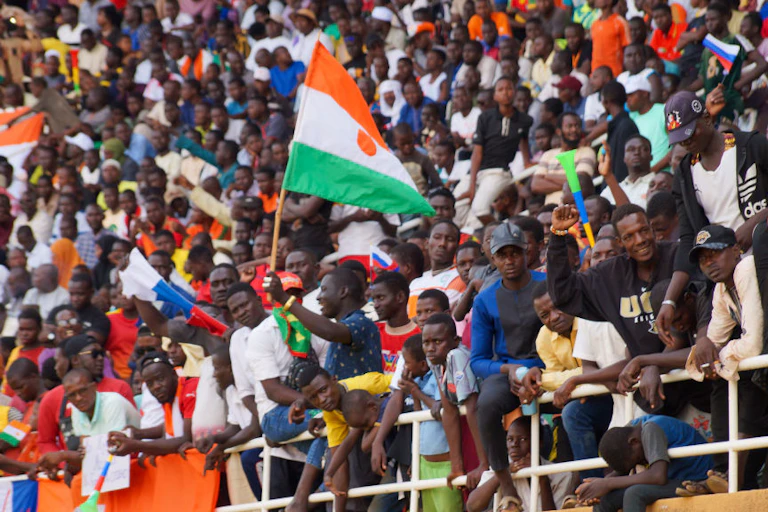
Slightly more than two years after Niger’s first peaceful handover of power from one civilian president to another, the military seized power in July 2023. The coup – the fourth in Nigerien history – follows on the heels of recent military interventions in Africa. Mali (August 2020 and May 2021), Chad (April 2021), Guinea (September 2021), Sudan (October 2021) and Burkina Faso (January and September 2022).
Since the end of the Cold War in 1991, the number of military coups has declined sharply. However, francophone west Africa now accounts for approximately two-thirds of all military coups that have occurred since then.
As a political scientist analysing African politics, I have studied military coups and their outcomes for the last decade and a half. In a recent article, Justin Hoyle, a doctoral candidate in political science at the University of Florida, and I demonstrate that since 1989, military coups across the world have resulted in two outcomes.
First is the withdrawal of the junta from executive power. This means the junta doesn’t participate or interfere in post-coup elections. While it is necessary for the transition to democracy, it isn’t sufficient in itself. This scenario played out in the Nigerien coup of 2010 and the Thailand coup of 2006.
Second is electoral rigging by the junta in favour of its own candidate. This scenario establishes a regime in which coup leaders entrench themselves in executive power.
Examining how military coups unfold is crucial to understanding a country’s path back to democracy. It also provides insights into the effect of coups on the quality of democracy.
The research
We studied five countries and 12 post-coup transitions: Egypt (coups in 2011 and 2013), Mauritania (coups in 2005 and 2008), Niger (1996, 1999 and 2010), Fiji (2000 and 2006) and Thailand (1991, 2006 and 2014).
Overall, we examined slightly more than a third of all military coups between 1989 and 2017.
Out of a total of 32 post-coup environments, we found that in half of all cases, juntas withdrew from executive power in the coup’s aftermath.
However, even with the military’s withdrawal from power, the transition period to civilian rule was highly volatile. Particularly in sub-Saharan Africa, counter-coup attempts by a rival faction within the armed forces intending to remain in power occurred rather frequently. This was the case most recently in Burkina Faso in 2015.
Although many coups result in the withdrawal of juntas from executive power, many of the cases from our study were near-misses – the country could’ve ended up under military authoritarian rule.
We examined four key variables and their influence on coup outcomes. These are:
the internal coherence of the armed forces
the ability of civil society organisations and political parties to mobilise against the junta
the deployment of donor leverage
trade dependency on regional and western partners.
Of these, we argue that the two that matter the most are: the internal cohesion of the military and the vibrancy of civil society groups.
The findings
In our analysis, we found that the single most important variable that accounts for different coup outcomes is the internal coherence of the military.
When there’s internal coherence, militaries generally feel inclined to withdraw from executive power. This is because holding on to power challenges their internal cohesion.
Internal cohesion is based on the factors that triggered the coup. If a coup occurs in response to threats to the country’s territorial integrity, to the preservation of public order, or to the military’s material or reputational benefits, the junta will have the backing of the military at large. This is because the benefits of seeking power outweigh the risks of not being in power.
If a coup occurs for reasons outside these, the junta either won’t seek power or will face resistance from within the military and withdraw. We found this confirmed in all the coups that we analysed.
Another relevant yet less significant variable is the positioning of civil society toward the junta.
Where civil society groups manage to rally the population to demand a return to democratic civilian rule, juntas depart from power. The most prominent example of this was in Egypt after the 2011 coup.
Interestingly, we didn’t find that aid dependency or membership in an international organisation with anti-coup rules exerted any discernible influence on juntas. This means that domestic variables – and in particular the drivers of the coup – influence political aftermaths.
What it all means
For the current transitions in parts of Africa, these findings are troubling.
In Sudan, Mali, Burkina Faso and Chad, militaries overthrew their governments because of threats to their countries’ territorial integrity or to the military’s material benefits. The juntas in these countries can rely on the backing of the military at large. This decreases the likelihood of a return to civilian rule.
The implications of our findings for Niger and Guinea are less straightforward, however. Here, coups were staged by a sub-section of the military, even though such a move wasn’t in line with the interests of the armed forces at large. Our research findings suggest a more volatile dynamic for these two post-coup states.
At this stage, no one can predict how the motives of Niger’s presidential guard will shape future action. Much will depend on coup leader Abdourahmane Tchiani’s ability to convince the military that a coup was the right thing to do politically.
Generally, military coups bode ill for democratic processes. In instances where juntas withdraw from power, democracies don’t emerge. When juntas rig post-coup elections, they become entrenched in power in the medium to long-term. This has devastating consequences for the political and civil rights of their populations.